La vie est belle
Info Artist
Bernard Quentin
In times of turmoil and uncertain times, everyone is relearning how to live and adapt their own way, but for most of us, the moments of introspection we have experienced in recent months have also allowed us to focus on what matters most in our lives. Family, friends, health, happiness, and personal fulfillment... ultimately, it is life itself that prevails, insatiable and luminous.
In times of turmoil and uncertain times, everyone is relearning how to live and adapt their own way, but for most of us, the moments of introspection we have experienced in recent months have also allowed us to focus on what matters most in our lives. Family, friends, health, happiness, and personal fulfillment… ultimately, it is life itself that prevails, insatiable and luminous.
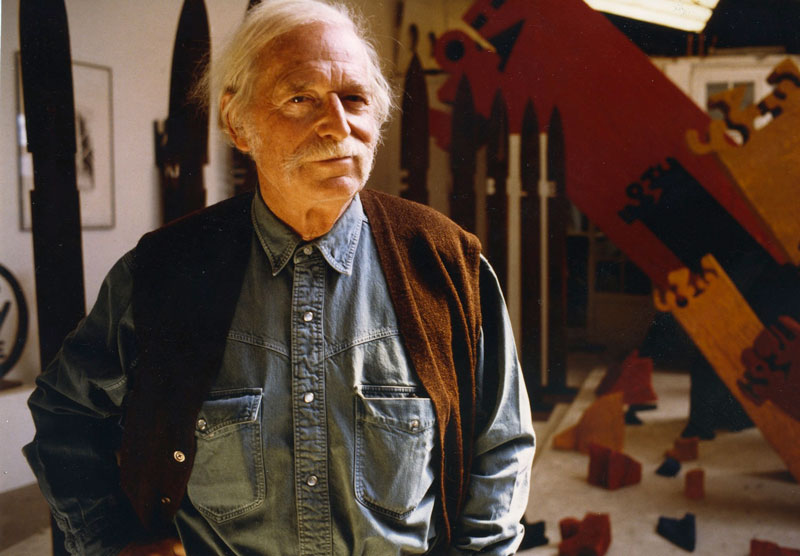
Amid the constant buzz of news fed to us by the media and social networks, a star nevertheless faded away in the greatest silence. A remarkable star, still shining with the energy of a child’s heart and the passion of a young man… at over 96 years of age.
Bernard Quentin was one of the last living French contemporary artists to have shaken up the 20th century and the art scene of the 1950s through the 1970s. A friend of Picasso, Boris Vian, Jean-Paul Sartre, Maurice Merleau-Ponty, Anne-Marie Cazalist, and Juliette Greco, whose life he shared in the late 1940s, Quentin took part in numerous exhibitions at the Galerie Maeght alongside Joan Miró, Alberto Giacometti, Calder, and Tàpies. He worked with Le Corbusier and later with Restany before traveling the world in search of various forms of language that have shaped the history of our world. He thus became a true driving force behind Semiotic art, and through his research, enriched several fields from automatic writing onward, to the point that Salvador Dali regarded him as a true “pioneer of cybernatic art and electronic writing”.
In the 1960s, he exhibited at the World’s Fair in New York a pulsating inflatable sculpture with programmed breathing. He became friends with Roy Lichtenstein and Andy Warhol, and was also the first designer to create 100% inflatable furniture (notably his Fauteuil Croissant). His monumental interventions in landscapes, heralding Land Art, led him in 1977 to found the collective L’Art+ alongside, among others, Jesùs Rafael Soto, Jean Messagier, Jean-Pierre Raunaud, and Pierre Restany. He also continued his work on “art-language”, notably developing the BABEL 62 project (renamed “QuentinBabelweb” in 1998), a language based on universal graphic signs, understandable by all.
The desire to establish a form of linguistic “universalism” through art demonstrates how deeply Bernard Quentin loved life and humanity, and how throughout his life was “a beacon toward the postmodern universality of tomorrow” (Pierre Restany). His presence and his smile will be greatly missed, but his body of work and his journey speak for themselves. For decades, they have captivated major collectors and artists, including the actor Gérard Depardieu, who fell in love with his work during the filming of Olé, directed by the artist’s wife, screenwriter, and director Florence Quentin, and who thereafter commissioned numerous pieces from the artist for his residence.
We would also like to pay tribute to the artist’s son, Alexis Quentin, for the remarkable work he carries out every day to keep alive the legacy of this exceptional artist, a major figure of 20th century art, whose considerable body of work still remains to be fully discovered.
Biography of Bernard Quentin, click here!