"Peacefully, let us concentrate on examining the scenes of the past that arise from our hearts as if in a dream.
The very moment we contemplate our present, it becomes the past; if we examine our successes and failures, our joys and sorrows, our achievements or our losses, or even old age and illness, everything is nothing but an illusion, like a flower in a mirror or the reflection of the moon on water.
This introspection is like a shadow, both invisible and omnipresent.
My painting is the practice of this gaze, a breath, a stroke, a touche, an awakening..."
Yang Liming
YANG LIMING and Analogous Images
Energy, vibration, respiration.
An artist creates with his hand but also his heart.
Reducing the works of the Chinese artist Yang Liming to pure abstractions would be a misinterpretation produced by the rigid frameworks of Western perception.
Yang Liming was born in 1975 and graduated from Sichuan Fine Arts Institute. However, he quickly distanced himself from what is commonly referred to as the "Sichuan mei yuan Situation", a phenomenon that led many artists of his generation from this province to produce similar, often unoriginal works.
In the early 2000s, he decided to study Western art—from Impressionism to Abstract Expressionism, including Cubism—and began exploring these different modes of painting in his own work. For a time, he experimented with dripping, fascinated by the power of dynamic lines in the compositions of Jackson Pollock. However, he soon returned to a technique based on painted lines made with an oil brush. Yet the "brushstroke" itself did not fully satisfy him. Because oil brushes did not extend far enough, he began favoring the use of the traditional Chinese brush, working in a style close to the calligraphy he had practiced as a child. A great admirer of Western classical music, Liming then discovered the immense potential for "muscality" within the brushstroke. The gesture of the painter, like that of the calligrapher, expresses qi, both vital energy and tonal vibration, to reflect his own sensations. From this emerges an image that translates the vision of that feeling in a "concrete" way. This concept—difficult to translate into French but that might be described as an "analogy" or an "analoguos image"— draws simultaneously from principles of Taoist Chinese philosophy, structures found in musical composition, and the gestural movement of calligraphy. Yang Liming's work, therefore, lies in the interrelationship among the senses (sight and hearing), the heart as the body's central element and engine of emotion, and the hand extended through the brush.
In 2006, the artist's first series devoted to the expression of the "analoguos image" through line mainly explored the structuring of linear segments. A few years later, his perception gradually evolved. Straight lines and right angles gave way to curved and cyclical lines, forming spatial compositions made up of rotating circles. These compositions are, in fact, the pictorial translation of the artist's tranquil state of mind. As he explained in a 2015 interview with Liao Wen:
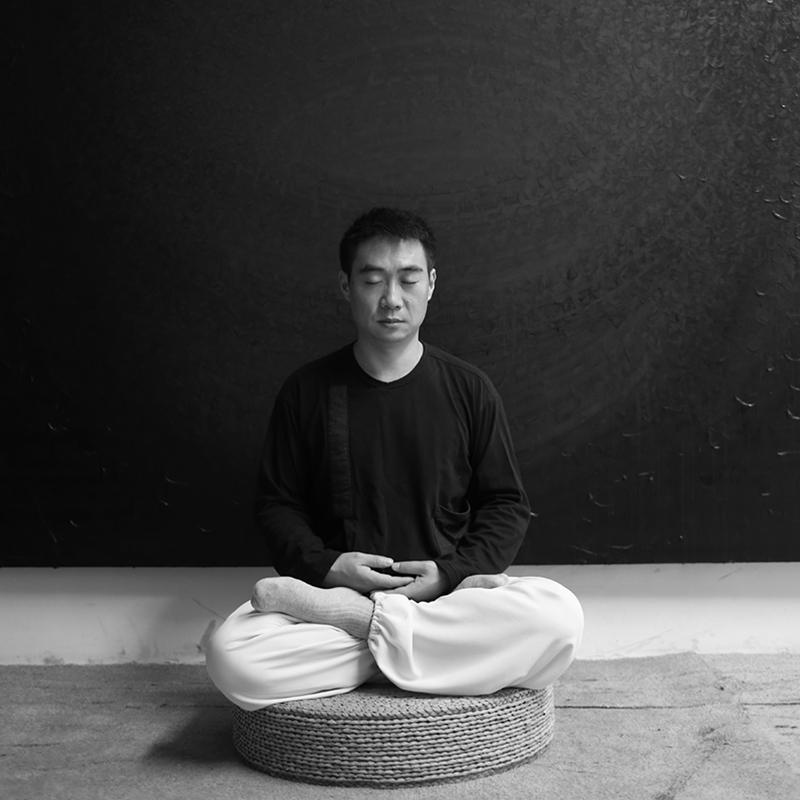
"When I am calm and meditate on my own inner mind, I can feel a rotating space slowly lighting up and producing many rays of light. What I paint is not merely abstract painting; it is literally a 'concrete' projection of what I feel. For me, all these elements are tangible, including color, structure, circles, or the direction of light".
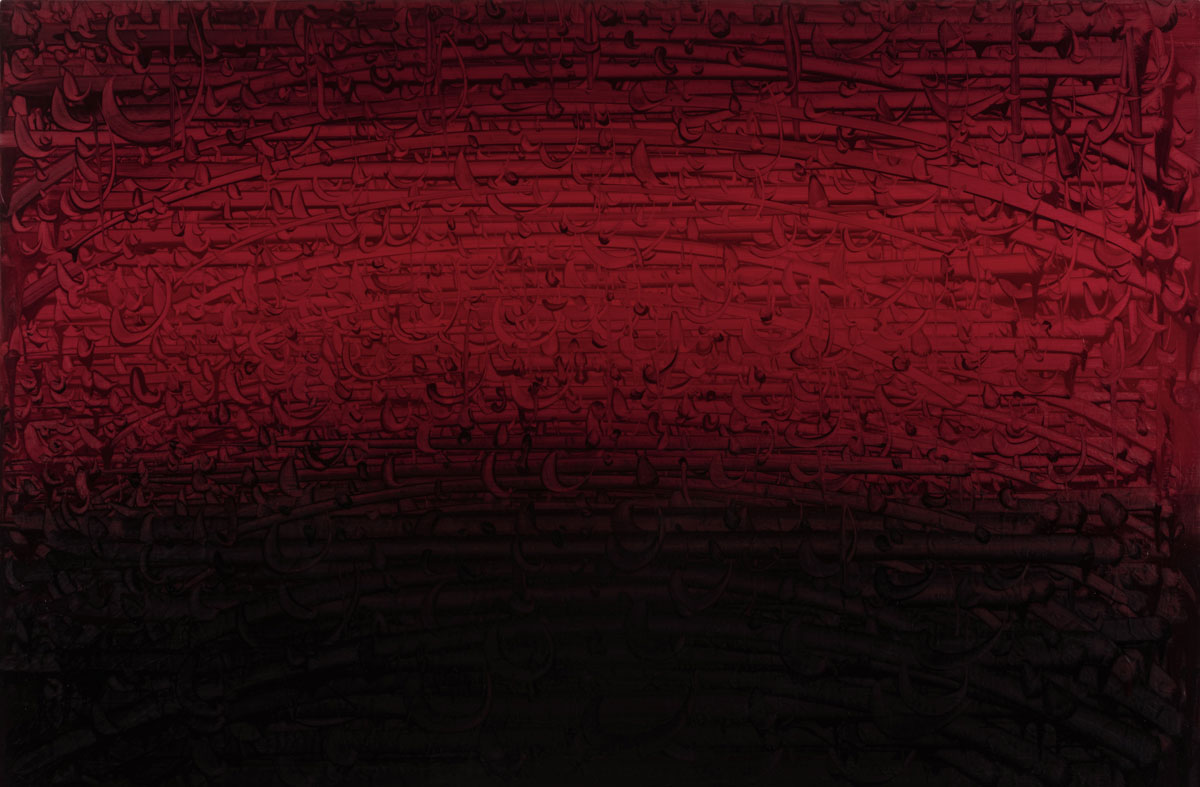
The use of color also reinforces this desire to paint the tangible reality of sensations. For Yang Liming, red symbolizes the passions of life and warmth. It expresses something akin to blood, the carrier of life, but sometimes also hints of pain. Black, on the other hand, represents family. Infinite black is not something dark that destroys us; in fact, it carries a warmth and a light emerging from within to help us. Different types of black tones—cool or warm—find their balance in the luminosity created by contrasts of color.
From the meeting and blending of these two colors arise vibrations, true undulations caressing the surface of the canvas, like the concentric circles formed when a stone falls into the center of a lake.
Echoes of heart, energetic reverberations of the hand upon the painted surface, traces of the past meeting the present to allow the future to emerge.
Analogies without references, doors opening onto the soul of the artist. Works that are as poetic as they are prosaic. Living spaces.
Press kit> click here